
In short
Saudi digital payments in 2025: what salons should change at checkout
Official Saudi data now points to electronic payments as the dominant retail behavior, which means salons need more than card acceptance alone. They need a faster checkout flow, clearer payment-method reporting, and invoice-ready operations so the front desk does not become a bottleneck.
If a salon owner still treats digital payments as an optional convenience, Saudi data from 2025 makes that position harder to defend. Cash has not disappeared, and no national statistic can predict how every client will pay. But the broad direction is now clear enough to affect operating priorities: checkout speed, payment visibility, and invoice readiness deserve more attention than they did a few years ago.
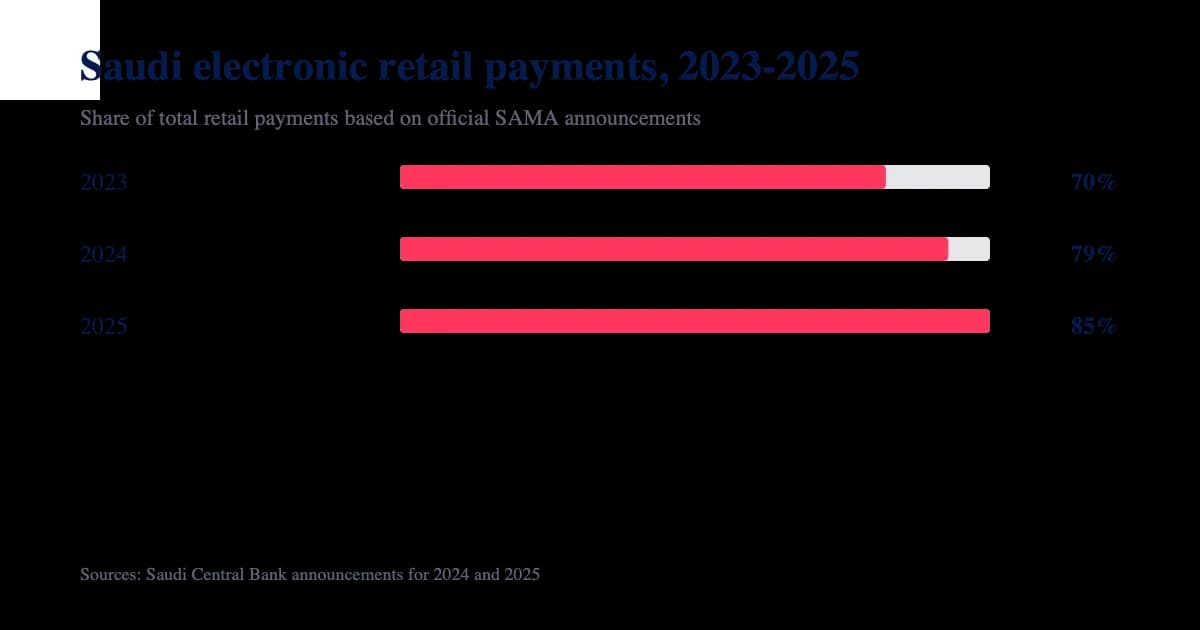
In an announcement published by the Saudi Central Bank on April 12, 2026, electronic payments accounted for 85% of total retail payments in 2025, up from 79% in 2024. The same announcement said the number of electronic payment transactions reached 14.6 billion in 2025, compared with 12.6 billion in 2024. Looking back one year earlier, the Saudi Central Bank's April 15, 2025 announcement reported that the 2024 share had risen from 70% in 2023, while electronic payment transactions increased from 10.8 billion in 2023 to 12.6 billion in 2024. These are economy-wide figures, not salon-only numbers, but they matter because salons operate inside the same customer payment environment.
What does that change for a salon in practice?
The first implication is simple: accepting cards or wallets is no longer the whole conversation. Once electronic payments become the standard behavior in retail, the management question shifts. Is checkout fast enough for a busy front desk? Does the invoice amount move into the payment flow without repeated manual entry? Can the owner see how much came through each payment method at the end of the day? Can branches or staff be reviewed without messy reconciliation work?
These questions matter because checkout is not just the final step of a visit. In a salon, it is where service, retail product sales, discounts, commissions, invoicing, and customer experience meet. If that handoff is slow or unclear, the cost does not only appear in front of the client. It shows up later in daily closeout, corrections, and follow-up work.
That is why this article should be read alongside practical pages already in the library, including how to connect Mada and Apple Pay for your salon and how to choose a ZATCA-compliant salon POS system. Those pages help with setup and evaluation. This research piece answers an earlier strategic question: should checkout improvement move up the priority list now?
A useful signal for salons: what happens as ticket size rises?
The Saudi Central Bank's 2023 Payments Usage Study found that cash dropped to just 19% of one-off consumer payments above SAR 300. That is not a salon-specific category, but it is still a valuable operating signal. Many color, skincare, treatment, package, or service-plus-product transactions in salons sit near or above that level. As the average ticket rises, non-cash payment behavior becomes more relevant, not less.
This does not prove that every service above SAR 300 will be paid electronically, and it does not mean every city or customer segment behaves the same way. It does mean that a salon still designing its checkout around a mainly cash-first assumption may be slower than customer expectations, especially for higher-value services or more structured branch operations.
The shift is not only about clients. It is also about how the business runs.
The same 2023 study reported that 96% of all business payments in Saudi Arabia were non-cash. That matters to salon owners even when the discussion starts with clients, because internal operations are moving in the same direction: suppliers, transfers, settlement, and record-matching increasingly depend on digital flows. The more a salon splits payment terminals, invoicing, and manual records into separate steps, the slower the follow-up becomes.
The study also showed that cards accounted for 51.0% of payment volume in 2023, while e-wallets reached 13.2%. Those figures do not mean every salon should prioritize the same payment tools in the same order. They do support a more important operational point: payment management is no longer a simple cash-versus-card choice. Salons need visibility into their payment mix, so they can identify whether friction sits in card handoff, invoice generation, wallet usage, or end-of-day settlement.
What does ZATCA add to the decision?
It is easy to think about payments only in terms of speed, but ZATCA makes the decision broader than that. The authority's official e-invoicing page states that implementation in Saudi Arabia moved through Phase 1 on December 4, 2021 and Phase 2 from January 1, 2023, with enforcement continuing in waves. For a salon owner, that means the payment decision is not only about accepting a method at the desk. It is also about whether the sale, invoice, and record stay connected in an orderly, reviewable flow.
In day-to-day operations, that changes the priority. A salon may already accept digital payments, but if invoice generation, checkout, or reconciliation still depends on manual handoffs, part of the operational value is lost. The better question is no longer "Do we accept Mada or Apple Pay?" It is "Do payment, invoicing, and reporting work together in a way that reduces waiting and mistakes?"
Three changes worth testing now
1. Measure actual checkout time. Do not rely on intuition. Track the process from payment request to invoice handoff. How many steps are involved? How many screens? Does staff need to retype the amount?
2. Review payment mix weekly. If demand for electronic payments is rising but reports still do not separate methods clearly, checkout improvements become harder to justify or prioritize. A clearer payments integration layer and direct POS terminal connection may save real time even before expansion.
3. Test e-invoicing readiness inside the same workflow. If the invoice is generated in a different path from the payment itself, or still needs later matching, that is a workflow issue worth reviewing through e-invoicing capability, not only through accounting controls.
What this research does not prove
This research does not prove that changing payment hardware will automatically raise revenue. It does not prove that every salon in every city needs the same checkout design. And because the Saudi Central Bank figures are national, not salon-specific, they cannot tell a branch owner exactly what her payment mix should be next month.
What they do provide is a defensible operating context. If electronic payments now dominate Saudi retail activity, if higher-value one-off transactions lean more heavily toward non-cash methods, and if e-invoicing remains part of the compliance environment, then salon checkout is no longer just a collection point. It is part of operational quality, service speed, and management visibility.
The practical conclusion for salon owners
If you are setting priorities this quarter, payments deserve a higher place than they did a few years ago. Not because market headlines are fashionable, but because official Saudi evidence points to a durable shift in payment behavior and operating expectations. The practical move is not to replace everything at once. It is to test checkout speed, review how clearly payment methods appear in reporting, and compare that against the real needs of your branch or branches.
What matters most for salon owners
- The shift is national, not marginalElectronic payments rose from 70% of retail payments in 2023 to 85% in 2025 according to the Saudi Central Bank.
- Checkout is now an operating decisionThe value is not card acceptance alone, but payment speed, invoice clarity, and reconciliation.
- The data guides, but does not guaranteeThe evidence is national, not salon-specific, so it should set priorities rather than promise fixed outcomes.
Figures worth reading operationally
These figures do not describe every salon on their own, but they show the direction around which customers and operations are moving.
Share of retail payments that were electronic in 2025
The Saudi Central Bank reported that the share rose from 79% in 2024 to 85% in 2025.
Saudi Central Bank 2025Electronic payment transactions in 2025
They increased from 12.6 billion in 2024 according to the same official announcement.
SAMA 2026 announcementCash share of one-off consumer payments above SAR 300
A useful signal for higher-value services, while still allowing for differences by city, segment, and category.
Payments Usage Study 2023Share of business payments that were non-cash in 2023
The shift is not only client-facing. Business operations themselves are moving further into digital payment flows.
SAMA 2023Share of Saudi retail payments that were electronic
The chart shows the officially announced retail-payment share for 2023, 2024, and 2025.
| Share of Saudi retail payments that were electronic | Share |
|---|---|
| 2023 | 70% |
| 2024 | 79% |
| 2025 | 85% |
Research limit
This evidence does not produce one checkout recipe for every salon
The sources are official but economy-wide, so they should be translated into local salon decisions such as checkout speed, average ticket size, and payment-method mix by branch.
Next step
Review the payment workflow before buying more tools
If the evidence moves checkout higher on your priority list, review payment integrations, terminal flow, and invoice handling before adding more disconnected tools.